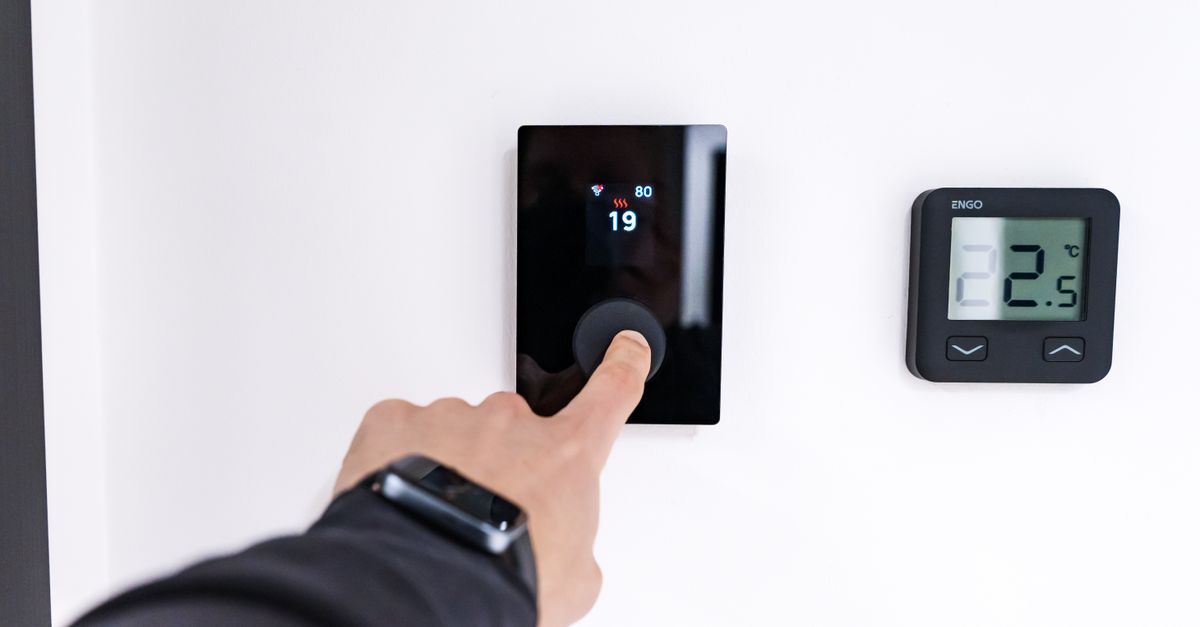
The promise of a smart thermostat is simple: save energy, save money, and live more comfortably. Many homeowners, myself included, install these devices with high hopes, only to be met with either negligible savings or an uncomfortable home. In my experience, the mistake I see most often is users setting their temperature swing too narrowly, often just one degree. While this might seem like a precise approach, it actually undermines the very efficiency benefits your smart thermostat is designed to deliver. What changed everything for me, and what I recommend to anyone serious about energy conservation, is embracing a slightly wider temperature swing, specifically around three degrees Fahrenheit.
Think about it: your home isn’t an insulated vacuum. Heat naturally transfers in and out. If your thermostat constantly tries to maintain an exact temperature within a very narrow band, it forces your HVAC system to short-cycle. This means your furnace or AC unit turns on, runs for a short burst, then turns off, only to turn on again a few minutes later. This constant on-off action is incredibly inefficient, wears down your equipment faster, and rarely achieves the stable comfort you’re aiming for. A three-degree swing, on the other hand, allows your system to run for longer, more efficient cycles, achieving a more stable and less noticeable change in indoor temperature, all while using less energy. It’s a small adjustment with a significant impact on your energy bill and the longevity of your HVAC system.
Key Takeaways
- A narrow temperature swing (1-2 degrees) leads to inefficient short-cycling and increased energy consumption.
- A 3-degree Fahrenheit temperature swing allows your HVAC system to run longer, more efficient cycles.
- Longer, less frequent cycles reduce wear and tear on your equipment, extending its lifespan.
- Optimize your thermostat’s schedule by pairing wider temperature swings with set-it-and-forget-it programming.
- Monitor your energy usage patterns for a few weeks after adjusting the swing to confirm savings and comfort.
The Hidden Costs of a Narrow Temperature Band
When I first installed my smart thermostat, I was obsessed with maintaining a perfectly constant indoor temperature. I set the swing to one degree – if it was 70°F, I wanted it to stay at 70°F, and I expected my system to keep it there. What I didn’t realize then was the physical and financial toll this was taking. My HVAC unit was constantly kicking on for short bursts. Imagine trying to drive a car by accelerating hard, braking, and then accelerating hard again every 30 seconds. That’s what a one-degree temperature swing does to your heating and cooling system.
This short-cycling is problematic for several reasons. First, your HVAC system consumes the most energy when it first starts up. There’s an initial surge of power needed to get the compressor or blower motor going. By forcing frequent starts, you’re repeatedly incurring this energy penalty. I noticed my energy bills weren’t dropping as much as I expected, and a deeper dive into my smart thermostat’s usage reports confirmed these frequent, short cycles. Second, and perhaps more critically, this constant on-off stress causes significantly more wear and tear on components like the compressor, fan motor, and relays. Over time, this can lead to premature breakdowns and costly repairs. I’ve heard countless stories from HVAC technicians about systems failing early due to this exact issue. A small adjustment like broadening your temperature swing by just two degrees can save you hundreds, if not thousands, in potential repair costs over the life of your unit.
Why Longer Cycles Are More Efficient
Moving to a three-degree temperature swing – for example, allowing the temperature to drop to 67°F before heating to 70°F, or rise to 73°F before cooling to 70°F – fundamentally changes how your HVAC system operates. Instead of short, frantic bursts, your system now runs for a longer, more sustained period. This is where the real efficiency gains kick in. During a longer cycle, the system reaches its optimal operating efficiency. The compressor, for instance, operates most efficiently once it’s been running for a while and has stabilized its pressure differentials. The same applies to furnaces, which perform best once the heat exchanger is thoroughly warmed up.
Consider the analogy of boiling water. It takes a lot of energy to bring water to a boil, but once it’s boiling, less energy is needed to keep it there. Similarly, your HVAC system works harder to change the initial temperature, but once it’s running, maintaining that change is more efficient. A three-degree swing allows the system to build and then dissipate thermal energy more effectively throughout your home’s thermal mass – the walls, furniture, and air itself. This leads to a more uniform temperature distribution and a less noticeable temperature fluctuation, because the system is given adequate time to do its job properly. The result is a home that feels more consistently comfortable, with fewer noisy starts and stops, and a lower overall energy footprint.
Setting Up Your Smart Thermostat for Optimal Swing
Implementing a three-degree temperature swing is usually straightforward within your smart thermostat’s settings, but the exact terminology might vary. Most smart thermostats, like the Ecobee or Nest, offer an option to adjust the ‘swing differential,’ ‘temperature differential,’ or ‘cycle rate.’ In my experience with various models, it’s usually found under advanced or installation settings. Look for a setting that controls how much the temperature can deviate from your set point before the system turns on.
For example, if you set your desired temperature to 70°F, a 3-degree swing means your heating would activate at 67°F and run until it hits 70°F, or your cooling would activate at 73°F and run until it hits 70°F. Some thermostats might require you to set the upper and lower limits explicitly, while others use a single differential value. If your thermostat only allows for a single number, like 1 or 2, understand that this is often the half-swing. So, a setting of ‘1.5’ would give you a 3-degree total swing (1.5 degrees above and 1.5 degrees below the set point). Consult your specific model’s manual if you’re unsure. The key is to aim for that approximately three-degree buffer zone.
Comfort vs. Efficiency: Finding Your Balance
One common concern with a wider temperature swing is, naturally, comfort. Many people worry that a 3-degree fluctuation will be too noticeable or uncomfortable. In my experience, this is largely a misconception rooted in the expectation of precise, instant temperature control. The truth is, most individuals do not consciously perceive a 1 or 2-degree temperature change, especially when it occurs gradually over a longer period.
The real comfort comes from the system running less frequently and more quietly. That constant on-off noise can be far more disruptive than a subtle, slow shift in temperature. Moreover, allowing the system to run for longer means the air in your home is being filtered and dehumidified (in the case of AC) more effectively during those cycles. This can lead to better air quality and a more pleasant indoor environment overall. If you’re currently running with a 1-degree swing, try bumping it to 2 degrees for a few days, then 3 degrees. Pay attention to how the house feels rather than constantly checking the thermostat display. You’ll likely find the difference is minimal, and the quiet consistency is a welcome change. It’s about optimizing for perceived comfort and actual efficiency, not just a number on a screen.
Integrating Swing Settings with Smart Schedules
While adjusting your temperature swing is a critical step, its effectiveness is amplified when integrated with your smart thermostat’s scheduling features. The real power of a smart thermostat lies in its ability to adapt to your lifestyle, heating or cooling only when necessary. By combining a 3-degree swing with a well-thought-out schedule, you can achieve substantial energy savings without sacrificing comfort.
For instance, program your thermostat to raise the cooling set point by 5-7 degrees (e.g., from 70°F to 77°F) when you’re at work, and lower the heating set point by 5-7 degrees when you’re away or asleep. The wider 3-degree swing then allows your HVAC system to efficiently bring your home back to your desired comfort temperature before you arrive or wake up, without constantly battling small fluctuations. This intelligent combination ensures that your system runs efficiently during those critical recovery periods and minimizes unnecessary operation when nobody benefits from precise temperature control. Many smart thermostats also offer ‘eco’ or ‘away’ modes that automatically implement these larger setbacks, and these work synergistically with a wider swing setting. It’s about being smart with your energy, not just controlling a single number.
Frequently Asked Questions
Q: What is a temperature swing on a smart thermostat?
A: A temperature swing, also known as a differential or deadband, is the range around your set temperature that your thermostat allows before activating your heating or cooling system. For example, with a 3-degree swing and a 70°F set point, the heat might turn on at 67°F and off at 70°F, or AC might turn on at 73°F and off at 70°F.
Q: Why is a 3-degree swing recommended for energy savings?
A: A 3-degree swing allows your HVAC system to run for longer, more efficient cycles. Frequent short cycles (caused by narrower swings) consume more energy during startup and cause greater wear and tear on your equipment. Longer cycles lead to better overall efficiency and less stress on your system.
Q: Will a 3-degree temperature swing make my home uncomfortable?
A: In my experience, most people do not notice a gradual 1-2 degree temperature change. While a 3-degree total swing might sound like a lot, the temperature shifts slowly over time, making it generally imperceptible. The benefits of quieter, more efficient operation often outweigh any minor perceived discomfort.
Q: How do I adjust the temperature swing on my smart thermostat?
A: The setting is usually found in the advanced or installation settings of your smart thermostat. Look for terms like ‘swing differential,’ ‘temperature differential,’ or ‘cycle rate.’ If your thermostat uses a single value, a setting of ‘1.5’ usually provides a 3-degree total swing (1.5 degrees above and below the set point). Refer to your specific thermostat’s manual for precise instructions.
Q: Does a wider temperature swing prolong the life of my HVAC system?
A: Yes, absolutely. Reducing short-cycling by using a wider temperature swing significantly lessens the stress and wear and tear on critical HVAC components like the compressor, fan motor, and starting relays. This can help extend the overall lifespan of your heating and cooling equipment.
Embracing a wider temperature swing on your smart thermostat, particularly around three degrees, is a straightforward yet powerful way to optimize your home’s energy consumption. It’s a shift from micro-management to macro-efficiency, letting your system work smarter, not harder. Give it a try, monitor your energy usage, and enjoy the comfort of a more efficient home. Your wallet and your HVAC system will thank you.